
From the Boston Made Newsroom. Published in full for Boston Made Reader.
EDITORIAL & ANALYSIS · September 30, 2026
By Nathanael H. Strickland
AI’s next chapter will be written in semiconductor plants, electricity networks, cooling systems, fibre routes and financing agreements. Boston Made’s AI Picks-and-Shovels Watch reveals why the economic stakes reach well beyond software—and why the Atlantic alliance has a practical interest in getting the foundations right.
The popular image of artificial intelligence is a conversation on a screen. The less visible reality is an industrial system: memory that must be manufactured, processors that must be tested, buildings that must be powered, heat that must be removed, and networks that must carry information reliably.
Across the Watch’s 26 dated research records through September 29, the pattern is increasingly clear. The frontier is moving through the physical economy. Our editorial conclusion is that the ability to turn capital and engineering into dependable, usable capacity may become as consequential as the ability to produce an impressive model.
That is a plausible shift in economic power, not proof of an inevitable “new world order.” The findings describe an evolving industrial landscape whose outcome will depend on investment, public decisions, competition, security and the benefits delivered to ordinary people.
What the Watch is actually showing
The AI Picks-and-Shovels Watch follows connected constraints rather than treating every announcement as a completed project. Its underlying research records distinguish company disclosures, forecasts, contracts, pre-orders, pilots and operating evidence. Across memory, testing, cooling, efficient processors, power conversion, modular delivery, connectivity and finance, those distinctions matter.
- Memory is a capacity and cost question. TrendForce’s September 29 research forecasts a 121% year-on-year increase in blended HBM selling prices for 2027. That is a forecast shaped partly by product mix; it is not a signed quote, a realised price or a 121% increase in the cost of every AI server.
- Testing is part of the industrial foundation. Teradyne’s Magnum E2 launch addresses next-generation DRAM and NAND testing. The announcement establishes a product offering, not independently measured customer throughput or guaranteed revenue.
- Custom silicon is creating another development pathway. SEMIFIVE announced an approximately $52 million development contract for a US fabless customer’s inference accelerator. Its H1 2027 tape-out and 2028 mass-production schedule remain planned milestones, not completed manufacturing capacity.
- Capital is reaching beyond the server room. Six Samsung affiliates announced a combined $1 billion investment in Helix, whose remit includes data centres, electricity infrastructure and fibre. The strategic interest is in an integrated system. An investment announcement does not itself establish that a campus has been energised or accepted.
- The supplier economy is already meaningful. Legrand’s September capital-markets material identifies data centres as 32% of first-half 2026 sales. Its portfolio spans power, physical infrastructure, controls, cooling and lifecycle services. That is a company-specific sales measure, not a measure of the whole economy.
- Connectivity is a long-term industrial commitment. Verizon and Corning announced a multiyear supply agreement involving more than 80 million fibre miles over 2027–2032, including next-generation AI infrastructure. Planned supply is not the same as fibre already installed and carrying traffic.
The remaining Watch lanes reinforce the same operating questions: how will cooling perform at the relevant temperatures; when will power equipment and prefabricated modules arrive; can efficient processors deliver useful work at lower energy cost; and do contracted GPU commitments become accepted capacity and collected revenue?
A memorandum of understanding, a customer prepayment and a functioning data centre are different pieces of evidence. Adding their headline values together would create a misleading picture. The useful measure is the movement from announced, to contracted, to delivered, to energised, to accepted, to productive operation.
How this could change the economy
First, AI investment can distribute work across a much wider supply chain. Electrical engineering, construction, cooling maintenance, cable manufacturing, testing and operations all become relevant to digital expansion. That creates potential opportunities outside the small group of businesses selling models. It does not establish the size, durability or local distribution of new employment; permanent operating jobs must be distinguished from temporary construction work.
Second, the economics of electricity become part of the economics of software. The IEA’s Electricity 2026 outlook expects data-centre expansion to account for roughly half of US electricity-demand growth through 2030. This is a forecast of incremental growth, not a claim that data centres will consume half of all US electricity. Reliable supply, grid flexibility and connection schedules consequently belong in any serious AI strategy.
Our inference is that constrained locations may face difficult choices about who pays for additional capacity and how new demand competes with existing uses. The answer will depend on regulation, tariffs, local network conditions and project design. An AI campus should be judged partly on whether it strengthens its host community’s infrastructure rather than shifting avoidable costs onto households.
Third, scarce components can favour large buyers. Companies with financing, procurement expertise and long-term supply arrangements may secure better access to chips, memory and power. Smaller businesses could depend increasingly on rented capacity. Competition policy, open standards and workable exit routes therefore matter alongside physical construction.
Fourth, productive adoption must justify the capital. More servers do not automatically mean better healthcare, more efficient public services or stronger manufacturing. Those gains require useful applications, suitable data, trained people and reliable operations. Demand can disappoint. Hardware can age faster than a financing plan expects. Energy availability and project acceptance can slip. The Watch’s evidence gates are a defence against confusing financial ambition with economic output.
The United States and Britain: a relationship with practical work to do
The US–UK connection already has a policy framework relevant to these constraints. The Technology Prosperity Deal memorandum signed on September 18, 2025 describes intended cooperation on AI infrastructure, research access to compute, model evaluation, civil nuclear technologies, quantum technologies and secure innovation.
The memorandum explicitly does not create legally binding obligations or commit expenditure. It is evidence of stated policy intent, not proof that every proposed programme has been funded or delivered.
Our analysis is that the next test of the relationship is implementation. Shared research access, compatible evaluation methods, resilient telecommunications, dependable energy and supplier qualification could make cooperation useful to universities, hospitals, manufacturers and smaller companies. Governments would still need to resolve procurement, security, jurisdiction and delivery questions.
For the United States, this expands the discussion from technological leadership to industrial execution. For Britain, it raises a corresponding question: how can access to advanced technology translate into durable domestic capability and public benefit? Partnership is valuable when it creates usable capacity, skilled people and institutions that can retain control of their responsibilities.
The supplier records also caution against treating the Atlantic as a self-contained economy. Important participants in this story operate across Asia, Europe and North America. Resilience calls for understanding those dependencies and developing credible alternatives, rather than pretending they can disappear through rhetoric.
Where King Charles III fits
King Charles III matters here through constitutional diplomacy and public convening, not through personal control of AI infrastructure or NATO policy. The Royal Family’s account of the monarchy’s role makes the constitutional distinction clear: the King is head of state; elected Parliament has the power to legislate.
There is also a direct, recent connection to the subject. In his April 28, 2026 address to the US Congress, the King discussed the Atlantic partnership, NATO, shared security, and cooperation in AI, drug discovery, fusion and quantum computing. He connected the relationship’s future to shared prosperity and responsibility for the natural world.
That provides diplomatic context for this editorial. It does not make the Watch a royal initiative, suggest a royal endorsement of Boston Made, or establish a particular policy position on the companies discussed.
Our interpretation is that his convening role can help keep the human questions visible: what kind of places will infrastructure create; how will prosperity be shared; and how can innovation respect communities and the environment? Those questions gain urgency as AI moves from digital promise into land, energy, industry and public services. Governments and accountable institutions remain responsible for the decisions.
Why NATO belongs in the discussion
NATO’s interest in AI is not simply a race to obtain the largest number of processors. Its revised AI strategy, published in July 2024, emphasises responsible use, interoperability, testing and validation, quality data, cooperation with industry and protection of vital components.
Our inference from the Watch is that these ambitions depend on infrastructure that remains dependable under pressure. Fragile power arrangements, insecure supply chains or poorly evaluated systems can weaken the capabilities that compute is supposed to support. Resilience involves maintenance, energy security, trustworthy information and skilled operators as well as advanced hardware.
Commercial infrastructure announcements do not automatically become NATO procurement programmes, and commercial AI clusters should not be described as military assets without evidence. The connection is a strategic one: civilian industrial capacity and responsible technological development can influence the options available to an alliance.
A new economic order is a choice about institutions
Used carefully, “a new world order” can describe a changing geography of production and influence. It should not imply a secret command structure or a predetermined political outcome. The evidence here is more concrete: the organisations and places able to assemble reliable power, computing, connectivity and capital may gain an advantage.
The constructive version of that future would combine technological capability with competitive markets, accountable institutions, secure cooperation and benefits that extend beyond infrastructure owners. A less attractive version would concentrate access, impose unexamined costs on communities and promise prosperity that the operating evidence never delivers.
For Boston Made, the useful response is to make the system legible. Follow the supplier. Check the source. Separate the forecast from the result. Ask who will use the capacity, who will pay for it, and when it will actually work.
The next economy will be judged by what it can reliably deliver—not by the size of its announcements.
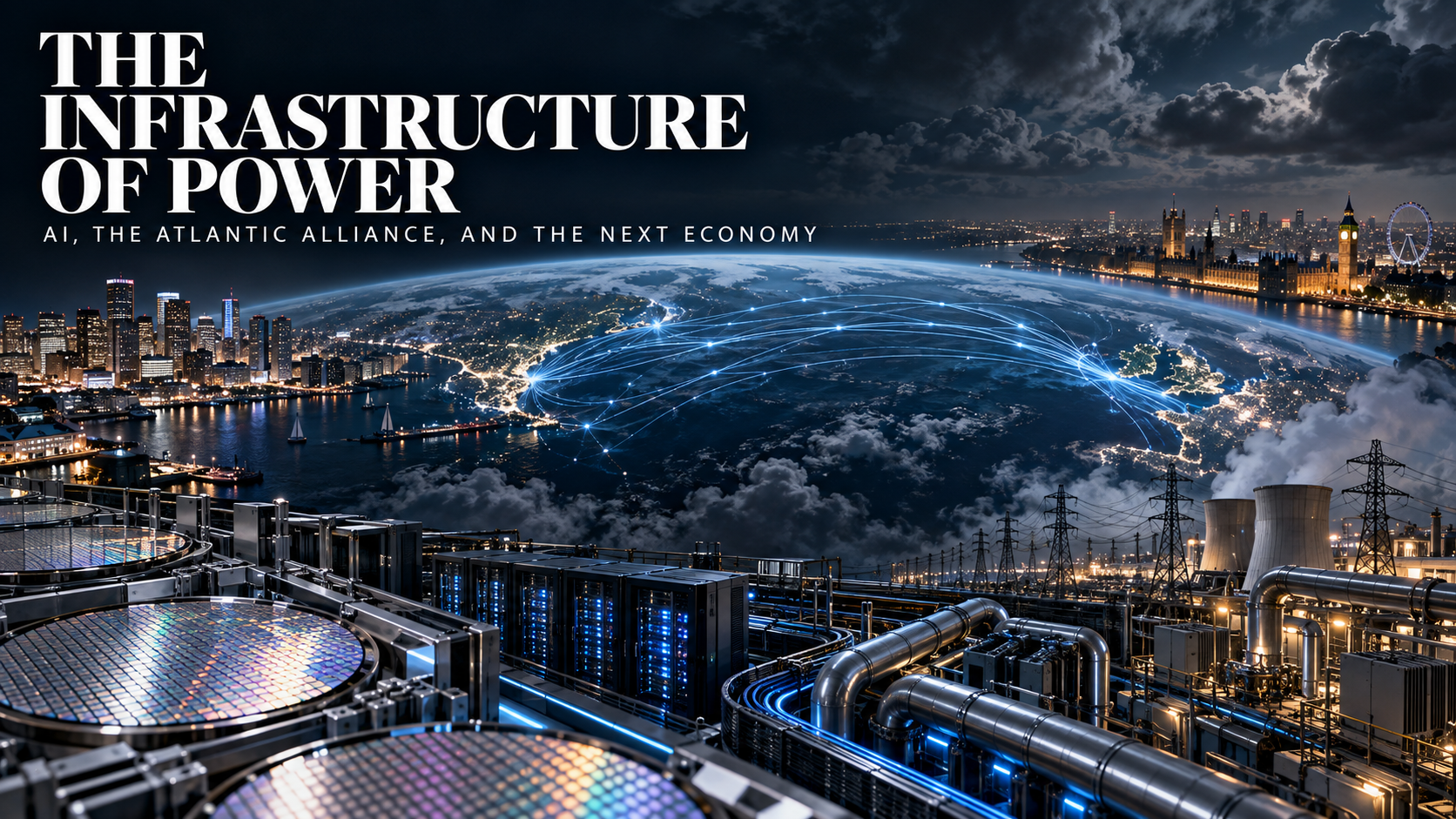
Editorial method: This article synthesises the AI Picks-and-Shovels Watch records through September 29, 2026 and the linked primary sources. Company announcements and forecasts are attributed; economic and geopolitical implications are editorial analysis, not guaranteed outcomes. The cover is an AI-generated conceptual illustration, not documentary photography. No royal, governmental or NATO endorsement is claimed.
Continue exploring: AI Picks-and-Shovels Watch · BOSSTOX research records · Boston Made App
For businesses: Discuss a website or research project · Ask about clearly labeled advertising placements.