Category: Readers

  • Helen Keller — My Religion (1927)

    Helen Keller — My Religion (1927)

    Helen Keller — My Religion (1927)

    Helen Keller’s own account of the spiritual beliefs that shaped her life.

    📖 Read it free

    In this book Keller explains her religious faith, which drew on the writings of the eighteenth-century thinker Emanuel Swedenborg. She describes how those ideas gave her a sense of inner light and freedom that her physical limits could not take away.

    Whatever a reader’s own beliefs, it is a moving look at how she made sense of her life.

    Part of the Boston Made Reader’s special collection Courage, Conscience & Service. Every book and document here is free to read.

  • Helen Keller — Out of the Dark (1913)

    Helen Keller — Out of the Dark (1913)

    Helen Keller — Out of the Dark (1913)

    Essays, letters and speeches on “physical and social vision”: Helen Keller’s writing about justice, work and the causes she fought for.

    By her thirties Helen Keller was a public speaker and activist. Out of the Dark collects her writing on the causes of blindness, working conditions, poverty and the rights of people with disabilities.

    It shows a Helen Keller many people never learn about in school: outspoken, political, and determined to use her fame to change how society treated the people it left behind.

    Part of the Boston Made Reader’s special collection Courage, Conscience & Service. Every book and document here is free to read.

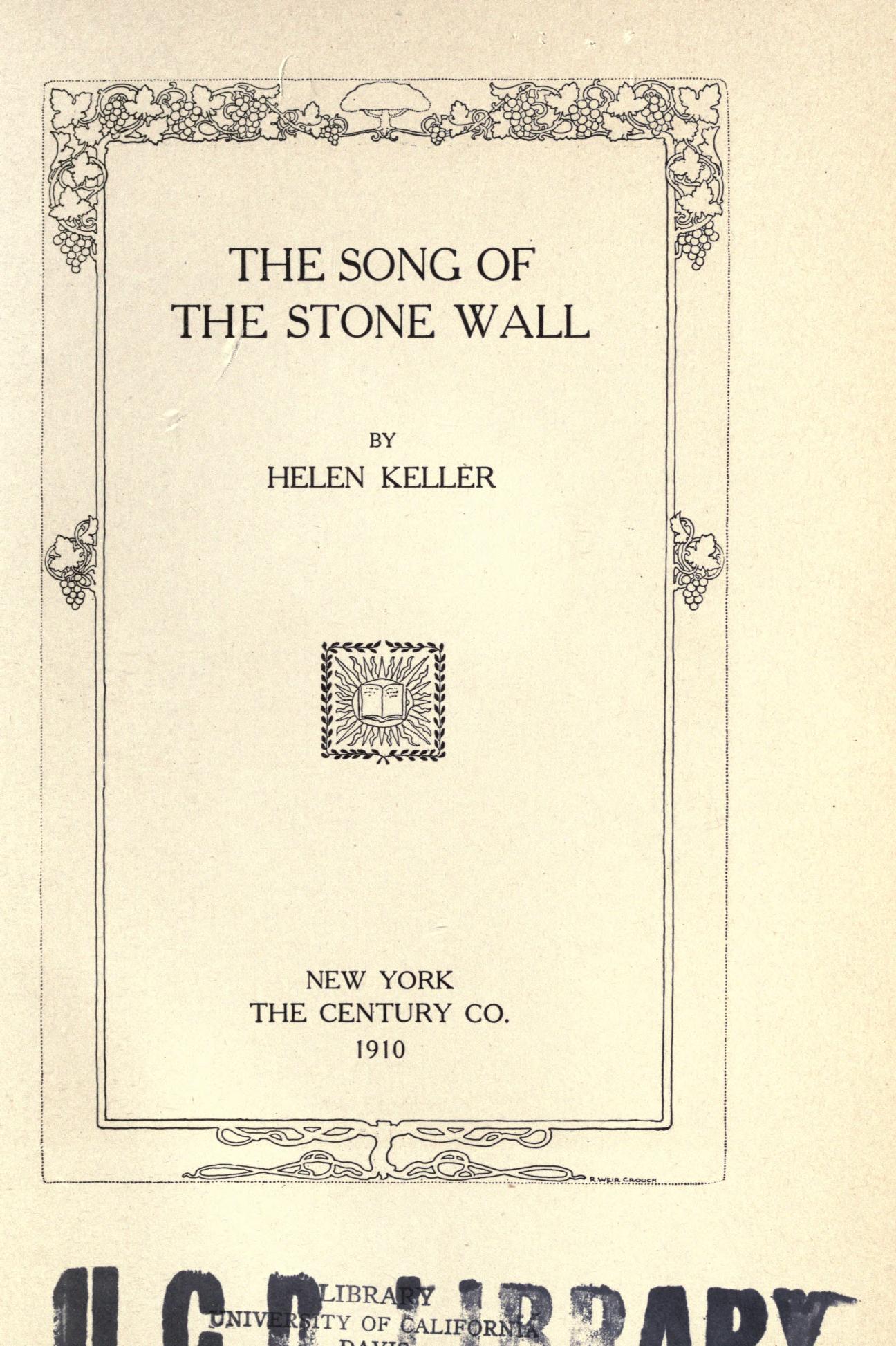
  • Helen Keller — The Song of the Stone Wall (1910)

    Helen Keller — The Song of the Stone Wall (1910)

    Helen Keller — The Song of the Stone Wall (1910)

    A book-length poem inspired by the old stone walls of rural New England, which Helen Keller explored with her hands.

    Walking the countryside around her home, Keller traced the stone walls built by generations of farmers. In this poem she imagines the lives of the people who cleared the fields and piled the stones, and what their work says about endurance and faith.

    It is her only published long poem, and a side of her writing few people know.

    Part of the Boston Made Reader’s special collection Courage, Conscience & Service. Every book and document here is free to read.

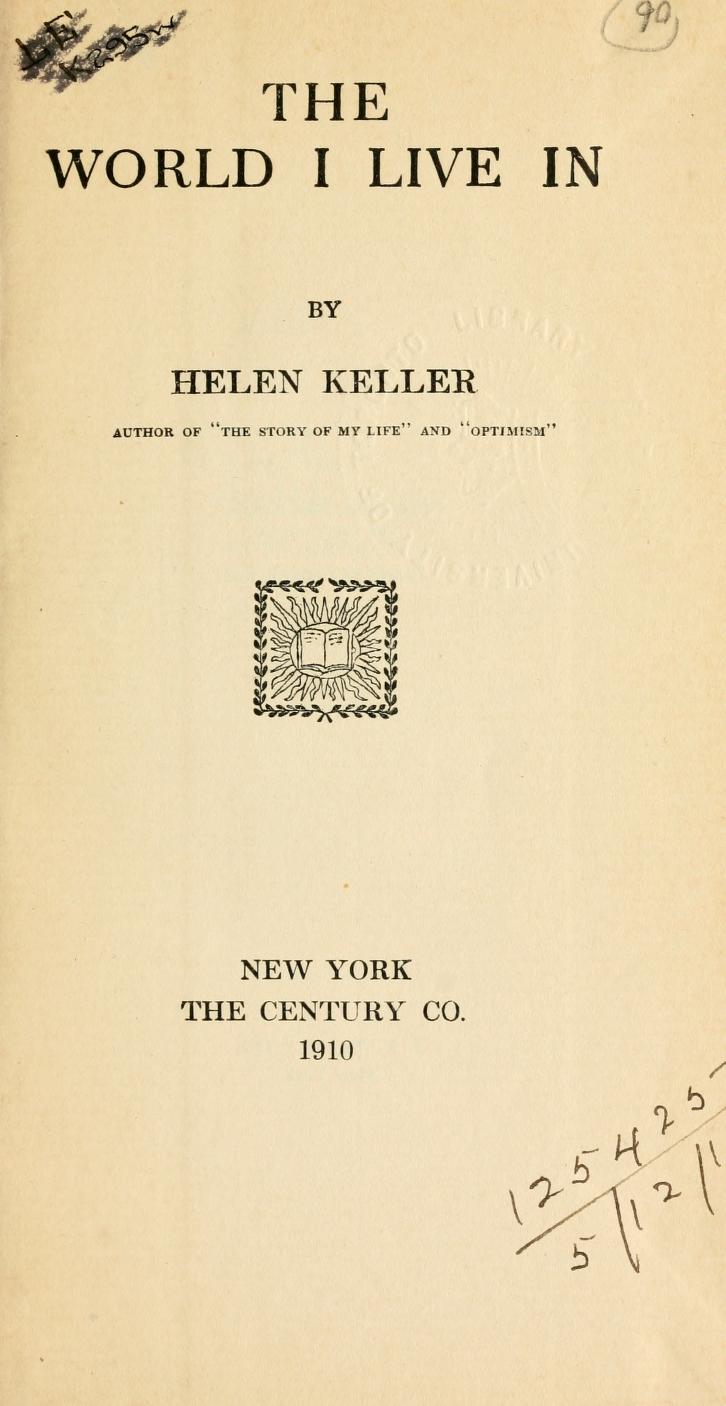
  • Helen Keller — The World I Live In (1908)

    Helen Keller — The World I Live In (1908)

    Helen Keller — The World I Live In (1908)

    Helen Keller answers the question everyone asked her: what is the world like without sight or sound?

    In this collection of essays Keller describes how she experiences the world through touch, smell and vibration, from the feel of a friend’s hand to the rhythm of a city street.

    It is also a book about imagination and dreams, and about how much of what we call “seeing” happens in the mind. Many readers find it even more remarkable than her autobiography.

    Part of the Boston Made Reader’s special collection Courage, Conscience & Service. Every book and document here is free to read.

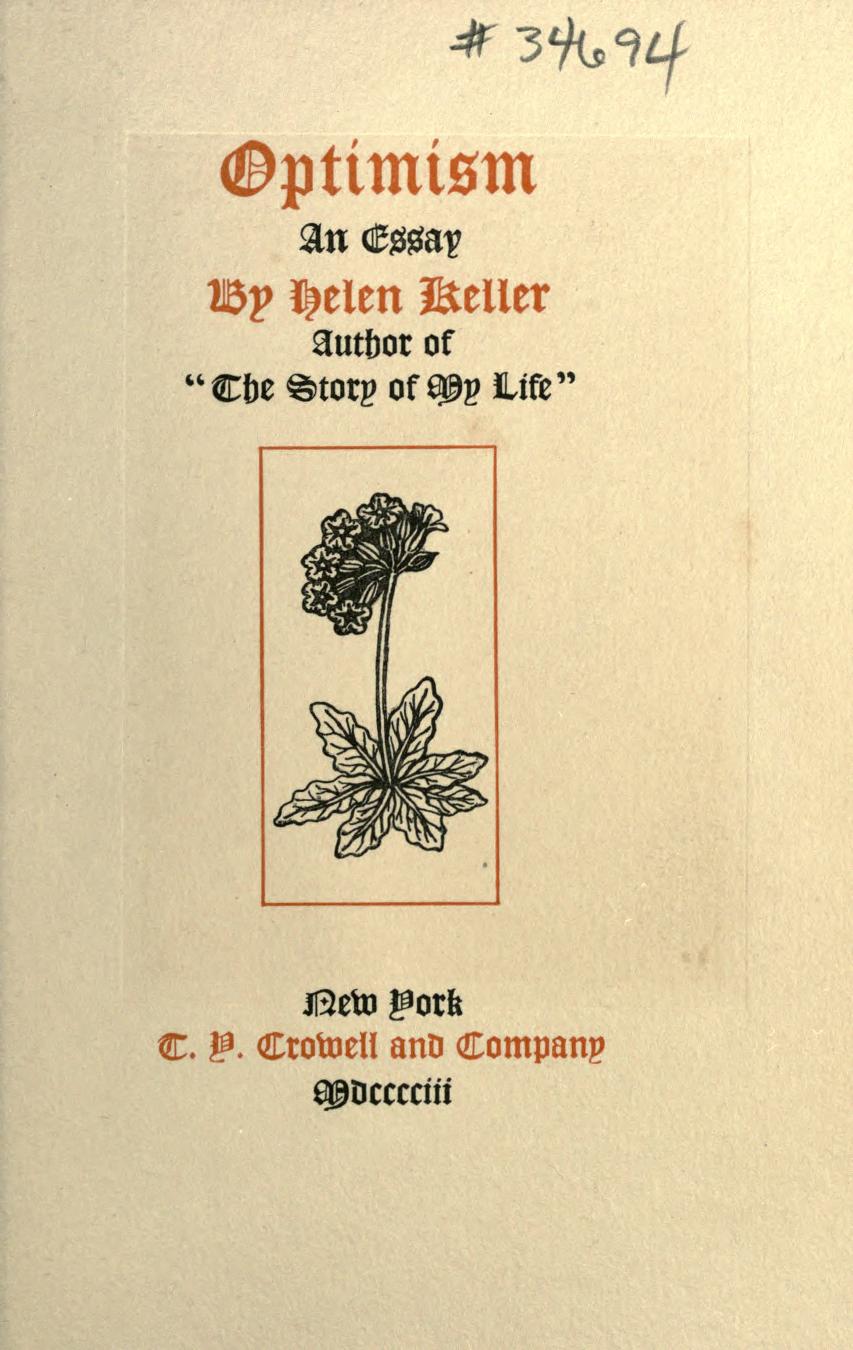
  • Helen Keller — Optimism: An Essay (1903)

    Helen Keller — Optimism: An Essay (1903)

    Helen Keller — Optimism: An Essay (1903)

    A short, fierce argument that hope is not a feeling but a way of living, written by someone who had every reason to give up.

    Published the same year as her autobiography, Optimism is Helen Keller’s personal philosophy in two parts: optimism within, and optimism without.

    She argues that optimism is earned by facing hard things honestly, and that it is the faith that leads to achievement. She looks at history, science and her own life to make the case that the world, slowly and unevenly, gets better because people refuse to accept that it cannot.

    It is short enough to read in one sitting, and it is one of the most quoted things she ever wrote.

    Part of the Boston Made Reader’s special collection Courage, Conscience & Service. Every book and document here is free to read.

  • Helen Keller — The Story of My Life (1903)

    Helen Keller — The Story of My Life (1903)

    Helen Keller — The Story of My Life (1903)

    Written while Helen Keller was a student at Radcliffe College, this is the story of a child cut off from sight and sound, and of the teacher who reached her.

    Helen Keller lost her sight and hearing to an illness before she was two years old. The Story of My Life, published in 1903, tells how a frustrated, isolated child became a reader, a writer and a university student.

    The water pump

    At its heart is Anne Sullivan, the young teacher who arrived at the Keller home in Tuscumbia, Alabama, in 1887. The book’s most famous scene comes at the water pump, when Helen suddenly understands that the letters Sullivan is spelling into one hand mean the cool water rushing over the other. From that moment, she wrote, everything had a name.

    Why it still matters

    The original edition also includes letters Helen wrote as a child and Anne Sullivan’s own reports on her teaching. Together they show that the “miracle” was really years of patience, persistence and daily work. It remains one of the most widely read autobiographies in the world.

    Part of the Boston Made Reader’s special collection Courage, Conscience & Service. Every book and document here is free to read.

  • The Constitution Act, 1867 (Canada)

    The Constitution Act, 1867 (Canada)

    The Constitution Act, 1867 (Canada)

    The founding statute of Confederation — originally the British North America Act, 1867

    📖 Go to the source

    For the complete official text, see the Government of Canada’s own justice laws archive: Constitution Act, 1867, Justice Laws Website.

    In force since July 1, 1867 — still marked every year as Canada Day — the Constitution Act, 1867 (originally enacted by the British Parliament as the British North America Act, 1867) united the Province of Canada, Nova Scotia, and New Brunswick into a single federal Dominion of Canada. It is the founding instrument of the modern Canadian state.

    A federal union

    The Act’s preamble declared the intent to form “a Federal Union” with “a Constitution similar in Principle to that of the United Kingdom” — combining British parliamentary government (a Crown-in-Parliament, with a Governor General as the Crown’s representative) with an American-style federal division of powers between a national government and provincial legislatures.

    Sections 91 and 92 — Dividing the powers

    The Act’s structural core: Section 91 lists the subjects on which the federal Parliament may legislate — including defence, trade and commerce, currency, banking, and criminal law — while Section 92 lists matters reserved to the provincial legislatures, including property and civil rights, hospitals, and matters of a merely local or private nature. This division of powers remains the backbone of Canadian federalism today.

    Growing the union

    The Act also set out the process by which other British North American colonies and territories could join Confederation — the mechanism through which Manitoba, British Columbia, Prince Edward Island, and eventually all of Canada’s current provinces and territories became part of the federation.

    From the BNA Act to the Constitution Act

    The statute was originally titled the British North America Act, 1867, reflecting its origin as an ordinary Act of the British Parliament in Westminster — Canada did not yet have full authority to amend its own constitution. When Canada “patriated” its constitution in 1982, ending the need for British parliamentary involvement in constitutional amendments, the 1867 Act was renamed the Constitution Act, 1867 and became, alongside the new Constitution Act, 1982 (which added the Canadian Charter of Rights and Freedoms), one of the two central pillars of Canada’s constitution.

    Primary source: Constitution Act, 1867 (formerly the British North America Act, 1867), Government of Canada.

    ADVERTISEMENT

    Bush & Company Everforth Creative Circle Boulineau's IGA Matt LAZ / Fairway Home Loans Boston Made Foundation

    ADVERTISEMENT

  • The Constitution of Mexico (1917)

    The Constitution of Mexico (1917)

    The Constitution of Mexico (1917)

    The revolutionary constitution that pioneered enforceable social and labor rights

    📖 Go to the source

    For the complete official Spanish text, see the Mexican Congress’s own archive: Constitución Política de los Estados Unidos Mexicanos, Cámara de Diputados.

    Promulgated in Querétaro on February 5, 1917 — still celebrated in Mexico as Constitution Day — the Constitución Política de los Estados Unidos Mexicanos was drafted in the final years of the Mexican Revolution, under President Venustiano Carranza. It remains in force today, though heavily amended over the past century.

    A pioneer of social constitutionalism

    What set the 1917 Constitution apart from its era’s other charters was its inclusion of enforceable social and economic rights, years before similar provisions appeared in Weimar Germany’s 1919 constitution — making it one of the first constitutions in the world to enshrine social rights as constitutional guarantees rather than mere legislative policy.

    Article 27 — Land and natural resources

    Declared that ownership of land and water within Mexico’s boundaries originally belongs to the nation, which has the right to transmit title to private persons and to regulate the use of natural resources for the public interest — the constitutional basis for the post-revolutionary land reform (ejido) system and, later, for the 1938 nationalization of Mexico’s oil industry.

    Article 123 — Labor rights

    One of the world’s earliest constitutional labor codes: an eight-hour workday, a weekly day of rest, a minimum wage, equal pay for equal work, the right to organize unions and to strike, and employer liability for workplace accidents — rights won directly from the Revolution’s labor movements and written into the constitution itself rather than left to ordinary statute.

    Structure of government

    The Constitution establishes Mexico as a federal, democratic republic composed of free and sovereign states, with a separation of powers among an executive (a President elected for a single six-year term, or sexenio, with no re-election), a bicameral Congress (Senate and Chamber of Deputies), and a judiciary headed by the Supreme Court of Justice.

    Primary source: Constitución Política de los Estados Unidos Mexicanos, Cámara de Diputados (Mexican Congress).

    ADVERTISEMENT

    Bush & Company Everforth Creative Circle Boulineau's IGA Matt LAZ / Fairway Home Loans Boston Made Foundation

    ADVERTISEMENT

  • The Maastricht Treaty — Treaty on European Union (1992)

    The Maastricht Treaty — Treaty on European Union (1992)

    The Maastricht Treaty — Treaty on European Union (1992)

    The treaty that created the European Union and set the path to the euro

    📖 Go to the source

    For the complete official text, see the EU’s own legal database: Treaty on European Union, EUR-Lex.

    Signed in Maastricht, Netherlands on February 7, 1992 and in force from November 1, 1993, the Treaty on European Union transformed the European Economic Community — a trade and coal-and-steel arrangement dating to the 1950s — into the European Union: a union with its own citizenship, a common foreign policy ambition, and a path to a shared currency.

    The three pillars

    Maastricht organized the new Union around three “pillars”: the existing European Communities (economic, social, and environmental policy, run through the supranational EU institutions); a Common Foreign and Security Policy (CFSP), coordinated between member governments rather than run by Brussels; and cooperation in Justice and Home Affairs. This pillar structure lasted until the Lisbon Treaty merged it back into a single legal framework in 2009.

    European Union citizenship

    The treaty created the legal status of “citizen of the Union,” held automatically by every citizen of a member state, alongside their national citizenship — carrying the right to move and reside freely within the EU, to vote and stand in municipal and European Parliament elections wherever in the EU one lives, and to consular protection from any member state’s embassy abroad.

    The path to the euro

    Maastricht set out the timetable and the economic “convergence criteria” — on inflation, government deficit and debt, interest rates, and exchange-rate stability — that member states had to meet to join Economic and Monetary Union. Those criteria led directly to the launch of the euro, first as an accounting currency in 1999 and then as physical notes and coins in 2002.

    Subsidiarity

    The treaty also wrote the principle of subsidiarity into EU law: outside its areas of exclusive competence, the Union acts only where member states cannot sufficiently achieve an objective on their own — a check meant to keep decisions as close as possible to the citizen.

    Primary source: Treaty on European Union (Maastricht Treaty), Official Journal of the European Communities.

    ADVERTISEMENT

    Bush & Company Everforth Creative Circle Boulineau's IGA Matt LAZ / Fairway Home Loans Boston Made Foundation

    ADVERTISEMENT

  • The Geneva Conventions (1949)

    The Geneva Conventions (1949)

    The Geneva Conventions (1949)

    The four treaties that form the core of modern international humanitarian law

    📖 Go to the source

    For the complete official texts, see the ICRC’s treaty database: The Geneva Conventions of 1949 and their Additional Protocols, ICRC.

    Adopted in Geneva on August 12, 1949, the four Geneva Conventions are the core of modern international humanitarian law — the rules that apply once a war has started, regardless of why it was fought. They are among the most widely accepted treaties in the world: 196 states, essentially every recognized country, are party to all four.

    The four conventions

    • First Convention — protects wounded and sick members of armed forces on land.
    • Second Convention — protects wounded, sick, and shipwrecked members of armed forces at sea.
    • Third Convention — governs the treatment of prisoners of war, including humane treatment, protection from violence and public curiosity, and the right to communicate with family.
    • Fourth Convention — protects civilians, including in occupied territory, from murder, torture, collective punishment, and deportation.

    Common Article 3

    A single article, repeated word-for-word in all four conventions, that applies even to conflicts not between states — civil wars and internal armed conflicts. It requires humane treatment for all who are not, or are no longer, taking part in hostilities (including surrendered or wounded combatants), and absolutely prohibits violence to life and person, taking of hostages, humiliating treatment, and conviction or execution without a fair trial by a regularly constituted court.

    Building on earlier conventions

    The 1949 conventions consolidated and expanded protections first established in 1864 (the original Geneva Convention, prompted by Henry Dunant’s account of the Battle of Solferino), 1906, and 1929, and were later supplemented by three Additional Protocols (1977, 1977, and 2005) extending protections to non-international conflicts and adding the Red Crystal as a third protective emblem alongside the Red Cross and Red Crescent.

    The International Committee of the Red Cross (ICRC), itself founded as a direct result of the original 1864 convention, serves as the conventions’ guardian and the primary neutral intermediary for prisoner visits, family tracing, and monitoring compliance in armed conflicts worldwide.

    Primary source: Geneva Conventions of 12 August 1949, International Committee of the Red Cross.

    ADVERTISEMENT

    Bush & Company Everforth Creative Circle Boulineau's IGA Matt LAZ / Fairway Home Loans Boston Made Foundation

    ADVERTISEMENT

This is a custom website designed and developed by Fenway Web, a marketing agency. Fenway Web is a part of Boston Made, Inc.

♫ Music Video Player
Press play — keeps playing while you browse