



Dear Sir or Madam,
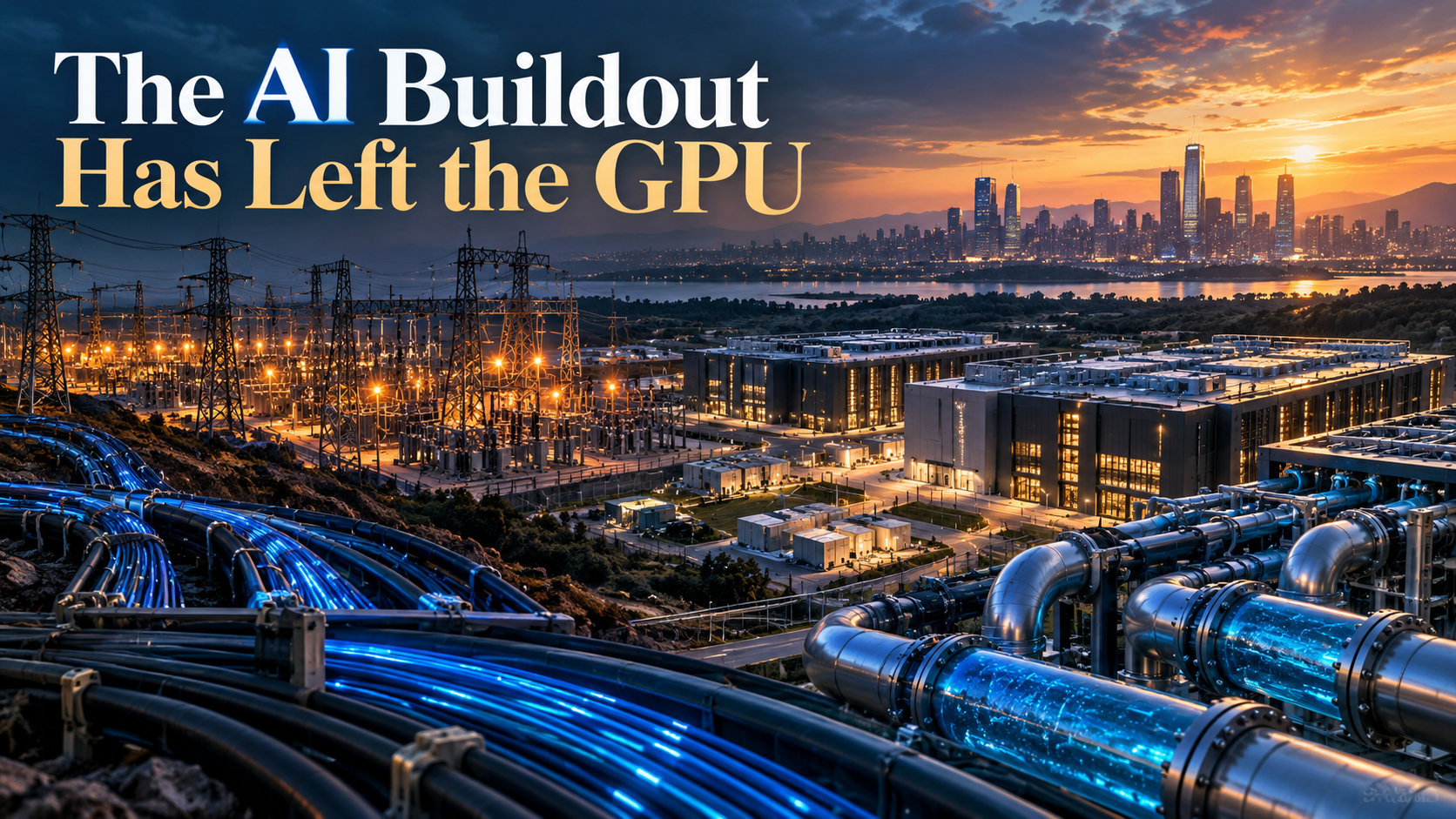
The AI story used to be told in chip launches. It is now being told in substations, cooling loops, fiber corridors, construction schedules, and contracts that reserve capacity years in advance.
That is the editorial shift readers need to understand. The GPU is still important, but it is no longer the whole story. A modern AI system is a chain: energy enters a site, power electronics condition it, cooling removes heat, networks move data, software keeps the facility stable, and commercial contracts turn the capital build into a business.
From chip scarcity to system scarcity
The early AI buildout rewarded anyone who could obtain accelerators. The current buildout rewards anyone who can put those accelerators into service. That difference sounds subtle, but it changes everything.
A server on a purchase order is not an operating cluster. A megawatt in a development plan is not a commissioned facility. A press release about a customer is not proof that revenue has started. The new discipline is to follow the evidence from announcement to contract, from contract to delivery, and from delivery to operating performance.
Contracted infrastructure is the new signal
QumulusAI’s September 2026 agreements illustrate the new pattern. The company announced $240.9 million of three-year take-or-pay contracts covering more than 2,000 NVIDIA Blackwell B300 GPUs. The customers were repeat buyers. That combination—hardware, term, take-or-pay, repeat demand—is much more informative than a broad statement about market opportunity.
Read the QumulusAI reporting ↗
Alignment Engine offers a different version of the same story. Its two four-year orders total about $1.17 billion, use AMD MI355X and MI455X GPUs, and include roughly $133 million in contractual prepayments. The customer is not named, and the GPU count is not disclosed. Those unknowns matter. Good infrastructure reporting should preserve them rather than reverse-engineer a number from a headline.
Power is a public story
AI facilities are now large enough to affect regional grid planning. Across the United States, communities are debating who pays for transmission, how water is used, what jobs are created, and how quickly a project should be approved.
That makes AI infrastructure a civic story as much as a technology story. A data center can bring tax revenue, construction work, and new industrial demand. It can also compete for power, alter land use, and create political pressure. The responsible question is not whether a community is “pro-AI” or “anti-AI.” It is whether the project has a credible plan for power, water, resilience, jobs, and local accountability.
Cooling is the hidden architecture
Dense AI racks turn thermal management into a first-order design problem. Liquid cooling, CDUs, heat exchangers, pumps, controls, and monitoring are not accessories. They determine how much compute can be installed and how reliably it can run.
Delta’s work on 800 VDC power, liquid cooling, microgrids, and prefabricated AI modules shows how these systems are converging. The facility is being treated as one machine rather than a building with servers inside it.
Read Delta’s architecture announcement ↗
Optical interconnect is becoming a headline
As clusters scale, network capacity becomes a physical constraint. Fiber, cable, transceivers, lasers, optical packaging, and test equipment are part of the AI supply chain.
Corning and AT&T’s multi-year agreement valued at more than $3 billion is a strong upstream signal. It reflects demand for fiber and cable that is being secured ahead of need, while research firms are describing optical interconnect as a critical battleground for AI factories.
Read the AT&T / Corning announcement ↗
Regional AI factories are a new operating model
Firmus’s agreements with Meta show how AI capacity can be distributed across regions instead of waiting for every workload to live in a hyperscale campus. Firmus says its portfolio spans Australia and Southeast Asia, with contracted capacity and expansion options and more than 900 MW of contracted capacity across the broader portfolio.
Read the Firmus announcement ↗
Regional capacity may matter because customers need proximity, sovereignty, latency, or speed. The best regional operators will combine power access, factory-built infrastructure, connectivity, and anchor customers. That is a different business from simply renting spare GPUs.
AI is operating AI
Aligned Data Centers’ partnership with Phaidra is a sign of a second AI market forming on top of the first one. Prism connects operational data to facility-specific intelligence for teams running power, cooling, mechanical, and IT systems.
Read the Aligned / Phaidra announcement ↗
That category will expand. Commissioning copilots, predictive maintenance, anomaly detection, thermal optimization, and operator portals all become more valuable as facilities become too complex for human memory alone.
How to read the next headline
- Is it a signed contract, a framework agreement, a customer claim, or a projection?
- Is the amount disclosed, and is the term disclosed?
- Is the capacity operational, under construction, contracted, or merely planned?
- Who supplies power, cooling, fiber, networking, financing, and operations?
- What remains undisclosed?
The Boston Made Reader will use those questions as a common evidence discipline. The executive view lives on Paxton Digital’s Shovel Watch ↗. The broader ecosystem map lives on Boston Made, Inc. ↗.
The takeaway
The AI buildout has left the GPU. It now lives in the physical systems that make tokens possible. Readers who follow only the chip will miss the power company, the fiber manufacturer, the cooling supplier, the regional operator, the facility software team, and the local officials who determine whether the project actually works.
Facts are linked to sources; interpretation is labeled as analysis. This is not investment advice.
Leave a Reply